

DevOps: The Engine of Modern Software Delivery
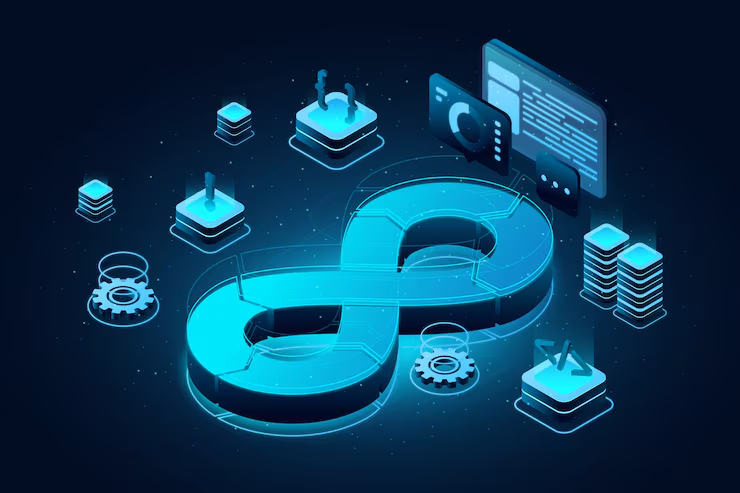
We bridge development and operations to deliver better software, faster. By automating infrastructure, streamlining deployments, and implementing continuous feedback, we transform how your teams build, test, and release
What is a back end in product management? “Back end” describes the parts of an application or program’s code that enable it to operate.
These include:
-
CI/CD Pipeline
-
Infrastructure as Code
-
Monitoring & Observability
-
DevSecOps Integration
It combines practices, tools, and a collaborative mindset to deliver software faster, more reliably, and with higher quality.
AWS (Amazon Web Services)
AWS is the world’s most comprehensive and widely adopted cloud platform, offering over 200 fully featured services from data centers globally. It provides on-demand computing power, storage, databases, networking, and tools that enable businesses to build sophisticated applications with flexible scaling, pay-as-you-go pricing, and enterprise-grade security. From startups to enterprises, AWS delivers the infrastructure backbone that powers modern digital transformation.
Azure (Microsoft Azure)
Azure is Microsoft’s cloud computing platform that seamlessly integrates with existing Microsoft tools and services while offering a comprehensive suite of cloud solutions. It provides infrastructure as a service (IaaS), platform as a service (PaaS), and software as a service (SaaS) for building, deploying, and managing applications through Microsoft-managed data centers. Azure excels in hybrid cloud scenarios, enterprise integration, and provides strong support for Windows-based workloads alongside extensive Linux and open-source capabilities.
Docker
Docker is a platform that packages applications and their dependencies into standardized, lightweight containers that can run consistently across any environment. Unlike traditional virtual machines, Docker containers share the host operating system kernel, making them more efficient, portable, and faster to start. This “build once, run anywhere” approach eliminates the “it works on my machine” problem and revolutionizes how software is developed, shipped, and deployed.
CI/CD (Continuous Integration & Continuous Deployment)
CI/CD is the automated pipeline that transforms code changes into production releases with minimal manual intervention. Continuous Integration (CI) automatically builds and tests code whenever developers commit changes, catching bugs early. Continuous Deployment (CD) automatically deploys validated code to production environments. Together, they enable teams to release software faster, more reliably, and with higher quality—turning weeks of manual processes into hours or minutes of automated workflows.